Olympic Endeavors – Fencing

The 30th Olympiad came to a close just 48 hours ago, but it already feels like the Olympic spirit has left the building. I, for one, am not quite ready to end the Olympic celebration, so I am going to keep the party going with…fencing!

Fencing began in Spain in the 1450’s and spread abroad through battlefield encounters with other nations. Modern fencing is one of only five events that have been a part of every Summer Olympics since the birth of the modern Olympic movement in 1896. The Boston Fencing Club traces its roots back even further, to 1858. It’s the oldest fencing club in the country, so it seemed like the most appropriate place to pick up a sword – specifically a foil – for the first time.
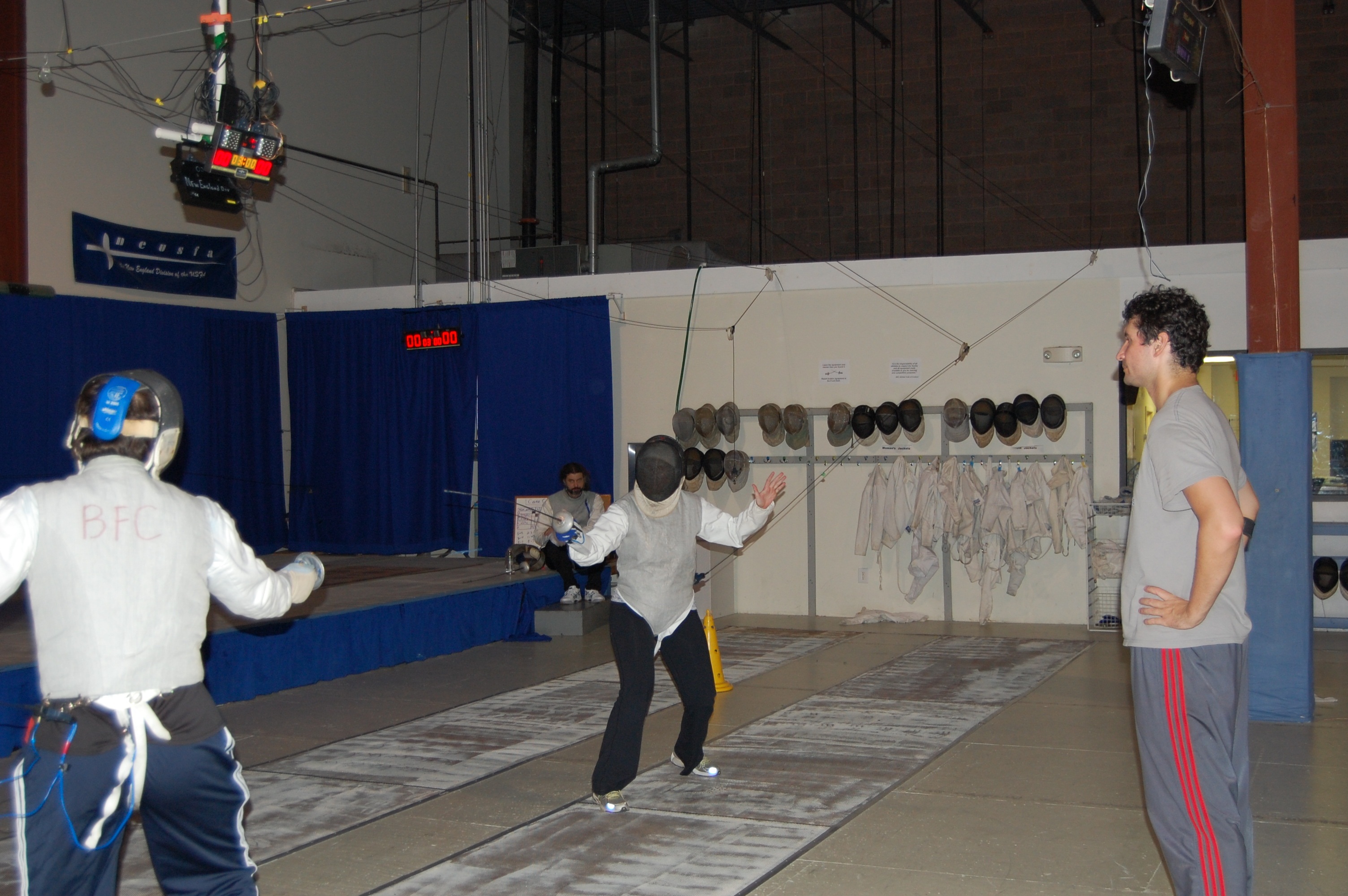
Fencing with Adam looking on

I started my evening of being en guard” with a private lesson with Adam, one of the club’s instructors, whom was a collegiate fencer and is a great teacher. We went over the basics including the three styles of fencing (foil — which I would be learning — sabre and epee), where I should be aiming (the upper torso) and how one scores (in foil, just a clean touch with the tip of the blade).  He outfitted me in all the necessary gear and I stepped on to the strip (the area that acts as the boundary in which one fences).

When Adam and I said “en guard” for the first time, I felt my pulse quicken. I was loaded with plastic and canvas protection, and the tip of the foil was not particularly sharp, but I was nervous that I would hurt Adam if I stuck him. A few times I actually asked him if my “touches” hurt. Of course they didn’t, but I think I was having trouble wrapping my mind around the fact that I was waving a sword at another person.

It’s not surprising that I was worried about Adam’s safety, and not necessarily my own. I do that a lot. I worry about my family and friends and I have a track record of compromising myself in favor of others. Depending on the circumstances, this can make me a very devoted friend, or alternatively, a masochist…and now I was brandishing a sword.

As we got going, Adam advised me to stop “bouncing around.” Fencers tend to move almost as a reflection of their opponent. If one takes a step back, their opponent will advance in their direction trying to push their opponent back, closer to the edge of the strip. I had not realized it, but I must have been hopping instead of fencing. Not the most aggressive or intimidating look, I’m sure.
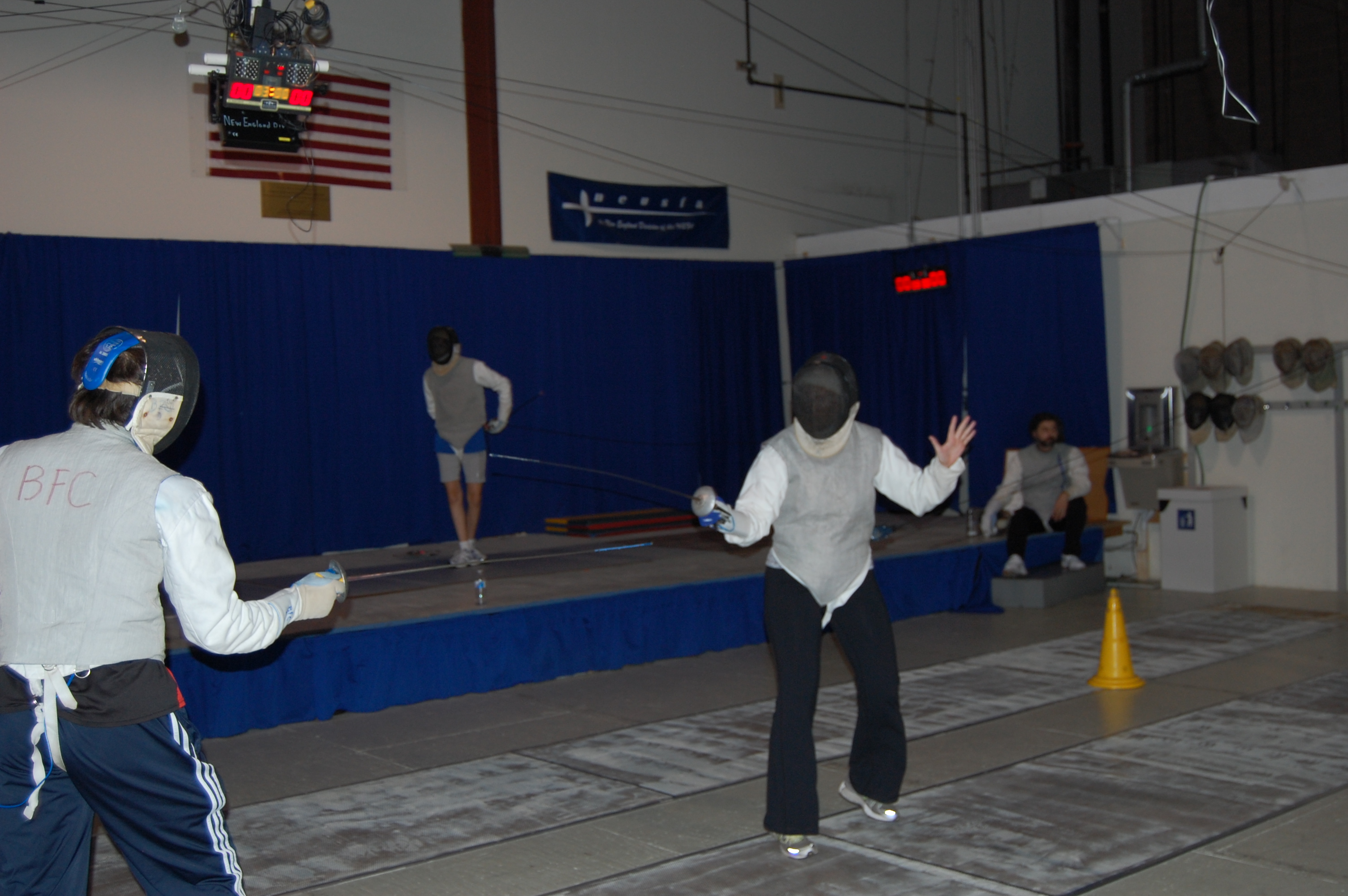
En guard!

After some initial sparring, Adam introduced the concept of “right of way.” In the simplest terms, the rule dictates that if both fencers touch one another at the same time, the fencer who began the offensive action gets the point. This may not sound all that complicated, but when you are on the strip with a sword in your hand and you have someone trying to stick you, it becomes difficult to keep track of who has right of way. This rule exemplified how subtle yet complex this sport is. Fencers must keep track of who has the right of way, while still being present in the moment, trying to “touch” your opponent while moving and blocking in an attempt to avoid being “touched” yourself.

Adam and I sparred a while and then I joined Adam’s adult class which, while filled with novice fencers, had weeks of experience on me. When I stepped onto the strip with my new opponents my adrenaline was really pumping. I felt as nervous as if the sword in my hand was real and sharp. If you had asked me about the lesson I had just learned, I probably would have said “right of what?”

I felt my heart pumping, and the killer instincts I never knew I had took over. I still felt myself bouncing a bit, but this time it was an aggressive bounce (I’m sure). I advanced towards my opponent with my foil pointed at his chest and after a few lunges and parries (blocks) I landed a touch. My opponent landed one as well, but it didn’t hurt, in fact I barely felt it. If the electronic score keeper had not buzzed I would likely not have noticed. I had no idea which one of us had the right of way, but I wasn’t waiting to find out, I was going after my opponent and if I lost a point, oh well, I was fencing!
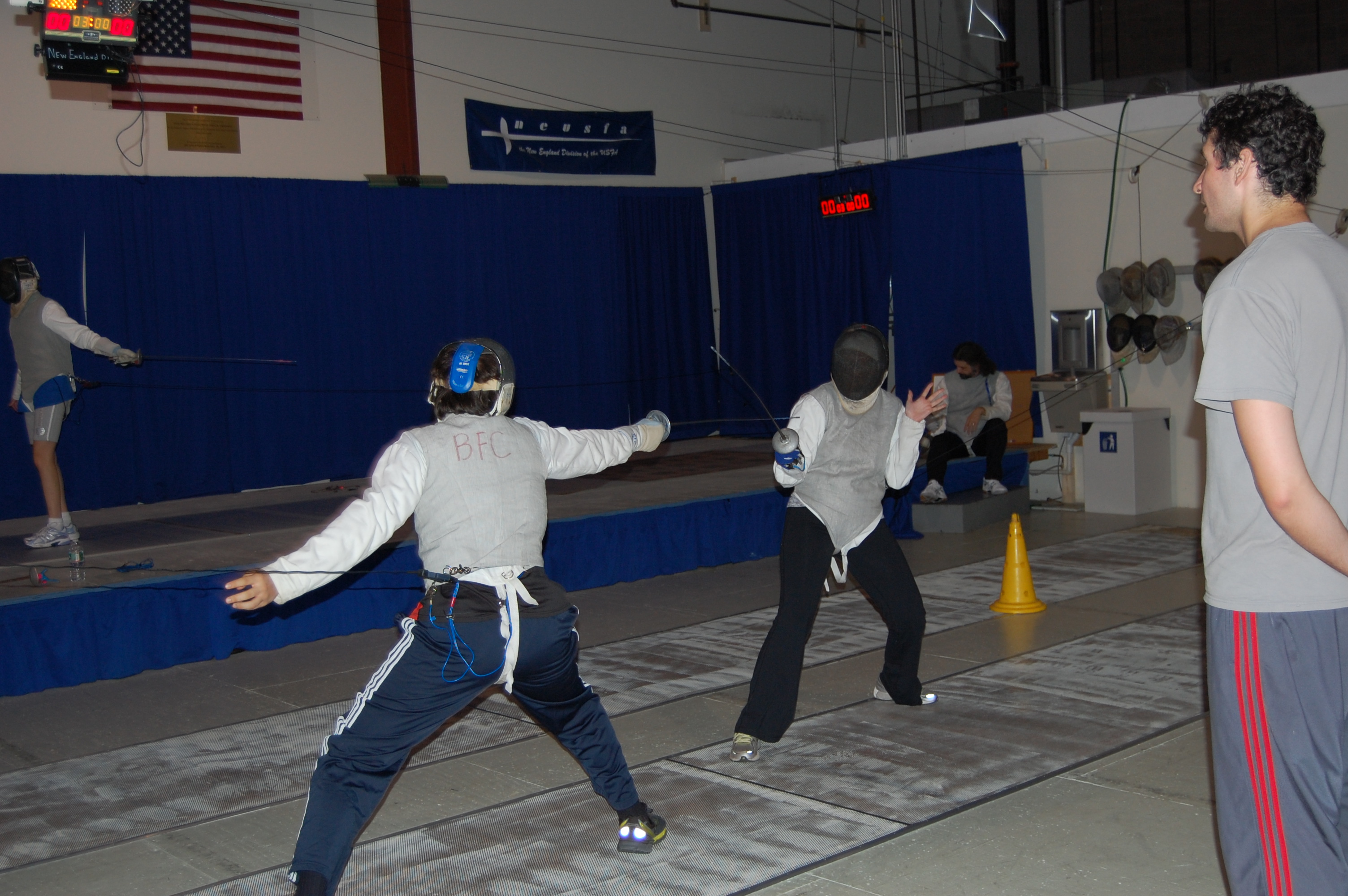
He got me on the arm

Now I am not in any way advocating aggressive behavior, but for me to fence a stranger and not stop to as how he is feeling, or unleash the classic emilyism, “Oh my goodness,” was quite a breakthrough. With a sword (albeit one used for sport) aimed at me, all my competitive and survival instincts took hold and not only did I defended myself, but I went on the offensive! While I am not totally sure who won, that is (almost) beside the point.

Many thanks to Adam and Helen and everyone at The Boston Fencing Club for letting me join their class and for helping me unleash my inner (harmless) aggressor. The club offer classes for children and adults, and has terrific teachers. This sport is like nothing else I have ever tried, combining very specific skills, agility and strategy. Plus, it is a totally fun way to work off an aggravating day.

I know it’s sad that my Olympic adventures have come to an end, but don’t fret.  There are a few additional physical feats that I couldn’t squeeze into this fortnight, so there will be a stray Olympic post or two over the next few weeks. And mark your calendars now (and get your requests in) the winter Olympics in Sochi, Russia begin in just 18 months and I will be hitting the slope — or maybe the bobsled track, or the curling ice — once that torch is lit.
Olympic Endeavors – Synchronized Swimming

I continue my celebration of the Summer Olympics with Synchronized Swimming, which began on Sunday in London. I have never known anyone who participated in this sport and didn’t know much about it, which of course meant I had to try it. I now realize Synchronized Swimming requires a lot of strength, coordination and grace in addition to water-proof make-up and exaggerated smiles. I thought it would be difficult to find an organized “sychro” (as NBC seems to call it these days) program, but thankfully I was wrong. The Andover/North Andover (Mass.) YMCA has an extensive program for children ages 6 to 19. They currently have 80 team members.

The Y’s head coach and team director, Svetlana Malinovskaya, was kind enough to offer me a private lesson seeing that the team is made up of kids, and swimming with them may have seemed a little creepy. Svetlana was a member of the Belarus National Team from the ages of 15-24 before moving to the U.S., so I was in very capable hands.

I arrived, uncharacteristically late and a little flustered, quickly changed into the only one-piece bathing suit I own, threw on my brand new swim cap and goggles and scampered onto the pool deck. Svetlana let me borrow her nose clip – more about that later – and we jumped into the pool as little girls wearing big smiles did laps of the pool; but they were not swimming laps of the pool. They were vertical in the water with their heads bobbing just above the surface and they were moving at a pretty good pace. I wondered if I could be as good as these eight year olds. Maybe one day.

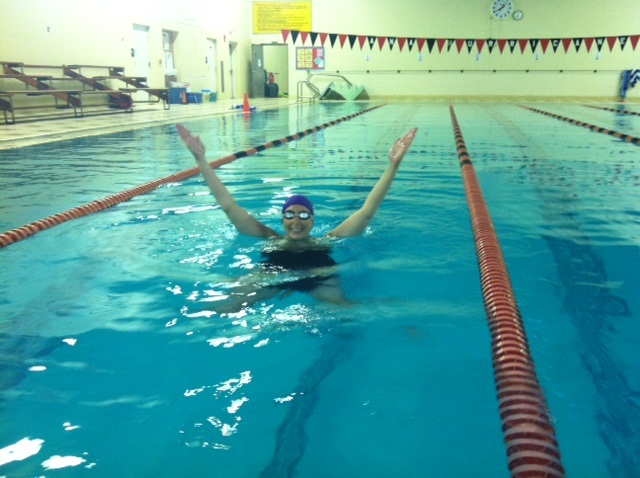
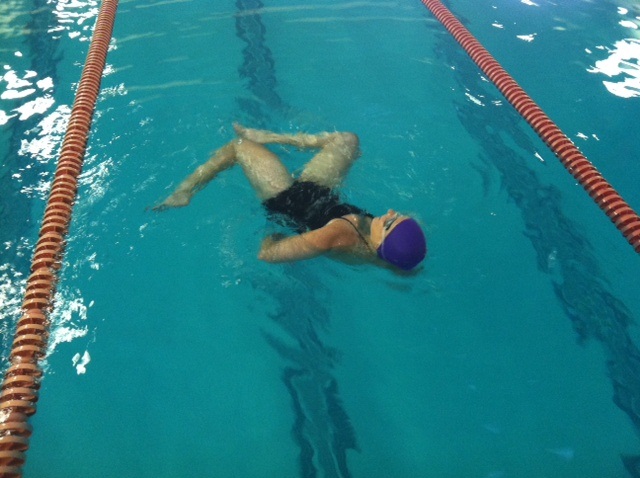
I am sculling underwater to spin myself around like a pinwheel

Svetlana and I started out with the basics: sculls. They are the hand movements synchronized swimmers use to propel them in different directions in the water. It’s all wrist action, tiny paddles under the water and the direction in which you move your hands dictates which direction you will float in. I did a layback (exactly what it sounds like, laying on your back at the surface of the water) and sculled in different directions. We then added a back somersault under the water. Svetlana explained this as if it was the next natural (and easy) step. For me, it was not. I could not get myself around. Svetlana said I could use my arms to power me around in a circle. That advice resulted in a wild flailing of my arms attempting to turn underwater.  I ended up floating to the surface, usually butt first. Despite my roly-poly nature in the water, Svetlana said I was a fast learner. Obviously, she was being very, very kind. I have to admit, despite appearances, my nose plug made things so much easier! I could struggle to somersault under water with relative respirational ease without water flooding my sinuses. I may buy one just to have.

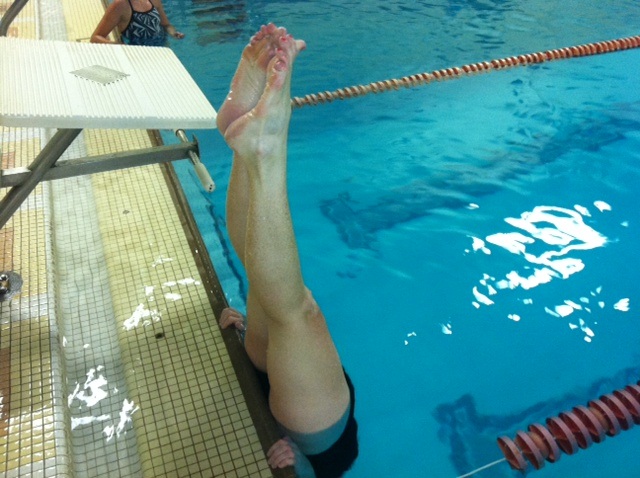
We moved on to head stands up against the pool wall and some “cranes” (extending one leg straight in the air while in a back

Practicing headstands against the wall of the pool

layout position). Getting into this position was tough enough…but then you have to scull to move your body around in a circle or in a specific direction. It never occurred to me how much physics is involved with successful synchronized swimming. As Svetlana explained to me, our lungs, being filled with oxygen, are our natural flotation device.  For women especially, it’s the weight of our hips that make us sink. In order to have control and stay, for example, upside down in the water, perpendicular with the surface of the water, your hips and lungs must be right on top of each other on the same line, meaning you have to keep your body rigidly straight.

Graphic courtesy of isport.com

Next I learned one of the most important moves in synchronized swimming: the eggbeater, which is similar to treading water in that it keeps your head above the water, but you are not using your arms – they are forming elegant circles above the water.  During eggbeaters each leg is rotating around in a circle from the knee down, but each leg goes in a different direction, hence the name. As I struggled, the little girls on the synchro team were doing eggbeaters around me – this move is now second nature for them, but as a novice, it made me feel totally uncoordinated. It’s similar to trying to tap your head with one hand and rub your tummy with the other. I just couldn’t get the rotation right without concentrating really hard…but then I forgot to smile, which is very important in the sport. I could get my hands up in a V, but then I would slowly sink because my eggbeaters were not quite strong enough to keep me afloat. As my head slowly slipped into the water despite the thrashings of my lower body, both Svetlana and I started to giggle. Yes, a grown adult barely keeping her head above water – both literally and metaphorically – during a synchronized swimming lesson is a funny sight. I even caught some of the little experts trying to contain their laughter as they continued with their laps.

Before I tried Synchronized Swimming it seemed to be one of those sports that tends to be the butt of jokes, not to mention SNL skits. In some ways I chose to try it because I thought it would make for a ridiculously funny post. But the joke was on me. Not only is it quite difficult, I actually really enjoyed it. I even asked Svetlana if there was a program for adults. Sadly, there is not one in Andover, but she said Worcester has a “masters” program for adults…while I am far from being a master (I didn’t even get to point of synchronizing my new moves in time with another swimmer), I may be one day.

One thing Svetlana said really resonated with me. As I writhed under the water trying to do a backflip, and came up for air with a smile on my face, she remarked that she was surprised that I seemed to be having such a good time. I wasn’t getting outwardly frustrated, and usually adults struggle with wanting to be too good too fast. I told her that I used to be like that (and boy was I). I wanted and expected to be good at something right away, despite never trying it before. Now I can see that it’s rather arrogant to think that way. But trying all these new things for this blog, week after week, seems to have made me unafraid of being terrible at things.  I am more open to the unknown now, happily ready to try new things for the experience of it, not necessarily to excel them. My inhibitions have disappeared and where this Type-A girl once stood, amazingly, a fearless young woman now stands…or floats as the case may be.

eggbeating…and sinking…but still smiling

I can’t thank Svetlana Malinovskaya enough for taking time out of her buys day to spend a few hours in the pool with me. The Andover/North Andover has a great synchronized swimming program, and I encourage anyone with little girls to check it out. I was not compensated in any way for this post.

Olympic Endeavors – Taekwondo

I love the Olympics. I mean I really love the Olympics. I get goose bumps during the opening and closing ceremonies and I cry at the end of the produced pieces on the athletes’ background.  They have inevitably overcome some obstacle to reach the Olympics, and that inevitably cues the waterworks. To celebrate the 30th Olympiad I am launching several weeks of “Olympic Endeavors.”  I will challenge myself by trying different Olympic events. This week, the Korean martial art of Taekwondo.

“Have you taken martial arts before?” my instructor Peter asked me as we stepped onto the mat. I said no, still tugging on my uniform which I thought made me look like the Stay Puft Marshmallow Man. I had walked into Jae Hun Kim Taekwon-do Institute right across the street from Fenway with absolutely no experience, and at that moment I thought maybe I had made a mistake. But Peter quickly made me feel at ease. We warmed up with some stretches, with Peter counting in Korean. Then we started with some basic forms (punches and kicks).

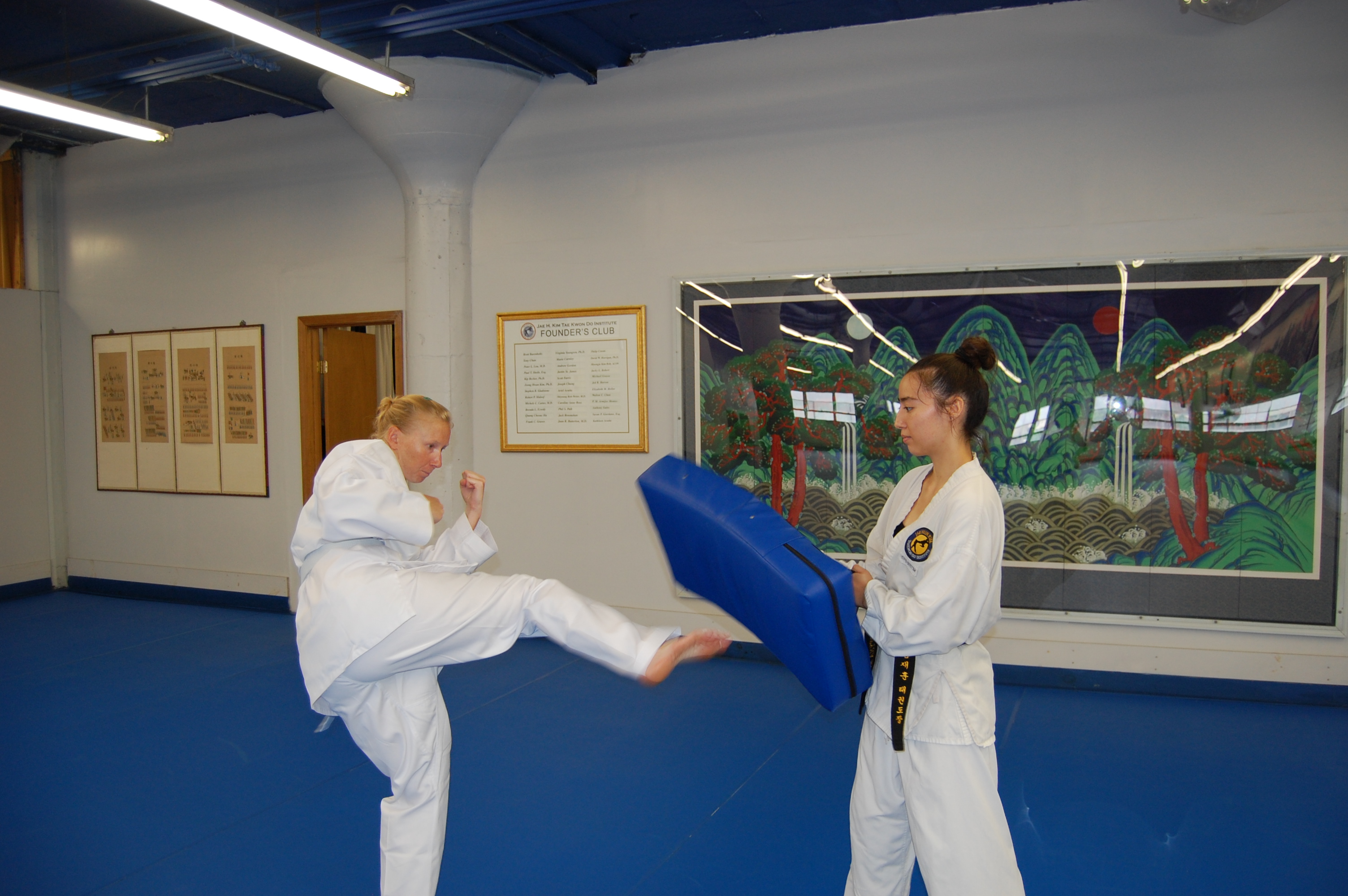
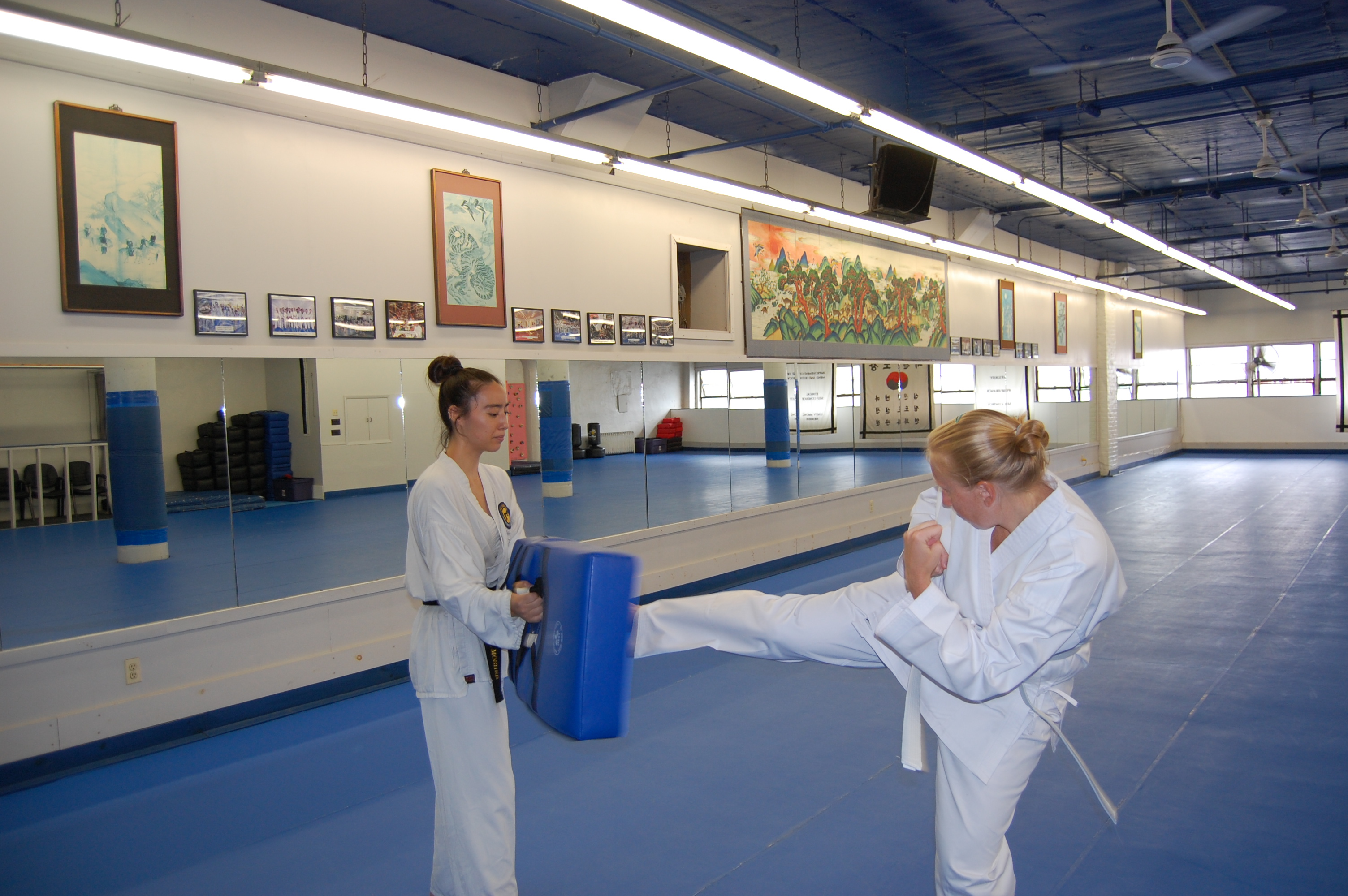
Practicing my roundhouse kick

I think Peter could quickly tell that I was very inexperienced, and obviously had never been in a playground fist fight, because he had to tell me over and over again to keep my thumb outside my fist when I punch. We started with front kicks and jabs in the air, moved on to roundhouse kicks and blocks and eventually Peter grabbed some pads and I actually had to aim my limbs at something. I started kicking and punching, very worried that I would hurt Peter. Why did I think my newbie kicks would injure a black belt? I also managed to lose my balance several times mid-kick which left me flailing various arms or legs in the air.

Grand Master Jae Kim, who founded the institute 38 years ago, came over to give me a few pointers. Both he and Peter picked up on the fact that I was holding my breath while going through the series of kicks and punches. They both told me to relax. Was it that obvious, I wondered, that I am an up-tight perfectionist? I guess so. I took some deep breaths and just tried to absorb all the lessons being presented. Like so many of my past “adventures,” as soon as I stopped trying to be good at Taekwondo, I actually became good at Taekwondo! While I wasn’t getting nearly as much extension, speed or impact as Peter, my kicks and punches weren’t too shabby if I do say so myself.

Almost more interesting than actually doing Taekwondo is the history of the sport, its lightning fast trajectory on to the international stage and the fact that Jae Hun Kim Taekwon-do Institute is a destination for people from across the globe who know – and want to know — Taekwondo.

Taekwondo is relatively new as sports go. It was created in 1955, but is based on martial art traditions that go back centuries. According to Mr. Kim, the sport spread around the world after soldiers who fought in the Korean War noticed how “tough” the Korean soldiers were and realized that Taekwon-do was an important part of their physical fitness routine. Taekwondo became an Olympic sport in 2000; meaning it only took the martial art 45 years to go from its infancy to biggest international sporting stage there is. Twelve years later, 128 athletes will compete in eight weight classifications (four for men, four for women) in these London games.

…It took a lot of practice

In addition to learning “forms” or “patterns” (the individual moves that I learned with Peter), The Jae Hun Kim Taekwon-do Institute offers instruction in the full spectrum of sparring (when you use those forms against an opponent). There are several sparring styles — all with different rules – including the type featured in the Olympics. There is also so-called “Full Range Sparring” which utilizes striking as well as grappling techniques. This type of sparring has become so popular that when my instructor, Peter, visited Korea last year everyone wanted him to teach them what they referred to as “Boston Style Sparring.” This anything-goes style originated at Mr. Kim’s studio in Fenway and helped it earn the honor of being named the top Taekwondo center in the world in 2009. Mr. Kim now has 15 centers all across the globe, and he teaches classes daily at the Boston location.

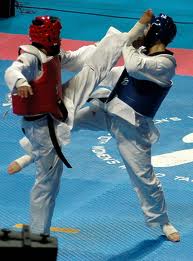
After going through the forms with Peter I watched other students in their classes and even got to watch some Olympic style sparring. It is intense. I could recognize some of the kicks and punches I learned in their movements, but barely. I really enjoyed my day of Taekwondo, but I had even more fun learning about the sport itself, its origins and how far it has come in such a short time. I think I may even go back for some group classes.

Photo courtesy of NBC Sports

While I did receive a complementary introductory lesson, I was not compensated in any other way for this post. Many thanks to Mr. Kim, Mr. Smith, Peter, Christine and Jen at Jae Hun Kim Taekwon-do Institute. Fellow Bostonians, we have a really amazing martial arts resource nestled right next to Fenway. If you are at all interested in Taekwondo I highly recommend you check it out. Olympic Taekwondo competitions start on August 8th, tune in. I will be!

Ready, Aim, Fire

One of the suggestions that have come my way more than once is for me to go hunting and chronicle the experience on the pages of this blog.  I take all the suggestions I get very seriously, but I have never felt ready to go hunting, mostly because I have never in my life held a gun. So this past weekend I took one small step towards being only slightly more prepared to hunt: I learned to shoot.

This blog has never been political, and I don’t intent to wade into those polarizing waters now, but let me back up a bit.  I was raised by progressive parents in Philadelphia, where guns were associated with crime, murders and all around bad stuff. After college I lived in New York City, where again, guns were bad. I have lived in Boston for over two years now, and perhaps it’s the city’s proximity to wilderness, but lots of people here not only have held guns, but shoot them on a somewhat regular basis…for sport. I have softened my formerly firm opinion that nothing good can come from owning a gun. I realize that many law-abiding people have been safely trained to fire weapons and hold licenses to own firearms. I am just not one of them. Do I want everyone who rides my bus in the morning to be carrying a concealed weapon? No.  Do I think people who have a valid license to carry a gun should be able to go out to the middle of nowhere and hunt animals in order to cook it up for dinner? Why not!

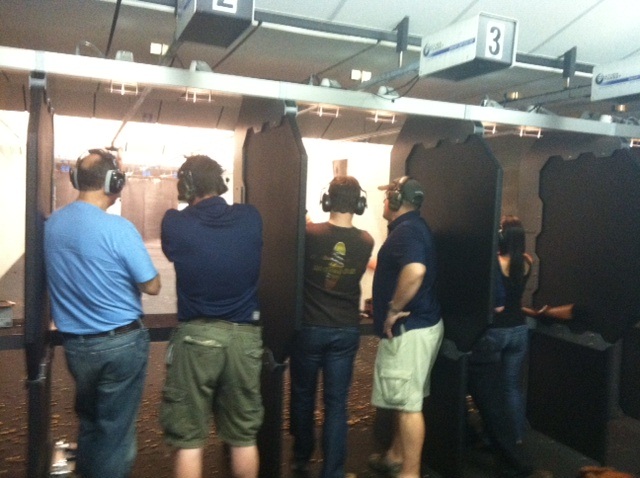
Some of my classmates on the range

I arrived at Mass Firearm School in Holliston, Mass, and as I sat in a classroom with other novices in a “Learn to Shoot” session, I suddenly got a little nervous. Actually a lot nervous.  My instructor was telling us about the NRA’s three rules for safely using a gun (always point the gun in a safe direction, keep your finger off the trigger until you are ready to fire, and something about the ammunition, but because he said he would be handling that  part, I stopped listening and focused on the first two rules) and the gravity of what I was about to do started to sink in in a way that I could almost physically feel the weight. This was serious.  I would be holding this contraption that could hurt someone — possibly myself — if misused. I have not always been good at my new activities at the start, and if I wasn’t good at this I could be dangerous.  Of course, my instructors were there to make sure I didn’t injure any of my classmates…but still.

We went over how to hold and aim a gun using plastic weapons, but even when I held the obviously fake handgun in my hands they started to sweat profusely. This was not a good sign. I started to imagine the gun slipping out of my slippery palms and shooting myself in the leg Plaxico Burress style.

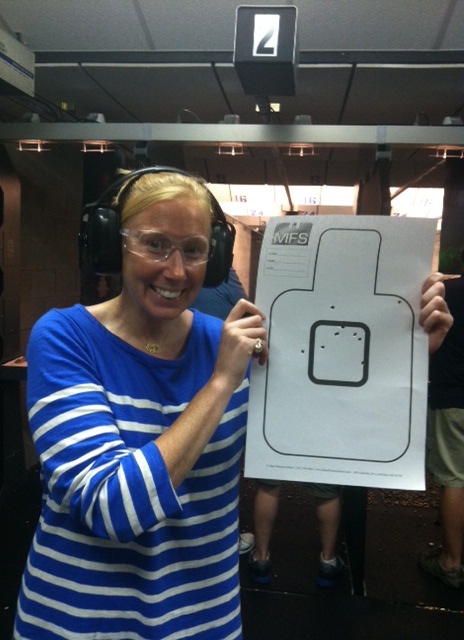
The target from my first try with the .22, not all that good, but I sure look happy!

After our classroom review we moved on to the shooting range. One by one, my classmates and I took our turn firing a .22 caliber semi-automatic hand gun, a revolver and a rifle, at targets 16 feet away.  I was surprised how loud guns are. I literally jumped and yelped each time one was fired. By the time I waited my turn to pick up the .22, my palms were really sweating. I aimed it at the target as instructed, with the near sight lined up with the one at the tip of the gun…then…as if in slow motion…I squeezed the trigger. I had expected the backfire to jerk my body in some direction, but I remained steady on my feet in the “athletic stance” that my instructor had suggested. I wasn’t the best shot with the .22, nor with the revolver that I tried next for that matter, and I had an especially hard time following the first rule to always point the gun in a safe direction, much to my instructor’s frustrations. No one’s perfect.

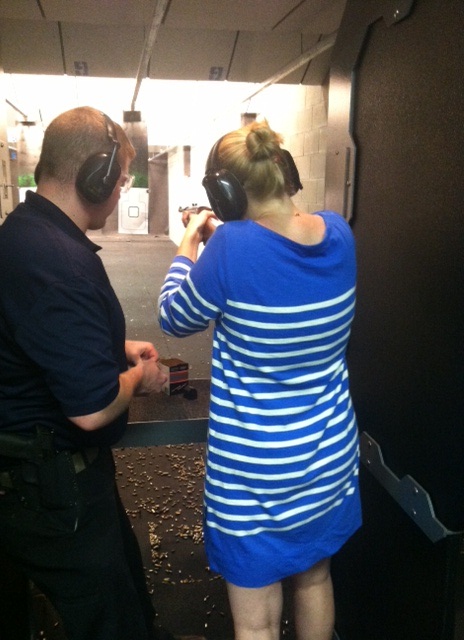
Me with the rifle

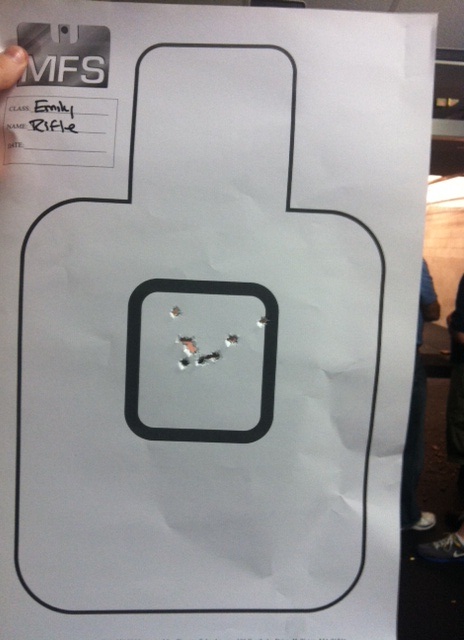
When I picked up the rifle it took a little while to get in the right position.  At first I held it with butt of the gun nestled in the crux in my right shoulder, but it turns out I am left eye dominant, so I had to switch around a bit.  Once I got comfortable, I started squeezing the trigger and to my great surprise, I am a phenom with a rifle. I mean really good! I felt a huge sense of satisfaction when my instructor handed me my target with ten bullet wholes all very close together in the center of the silhouette. Who knew this  girl from the not-so-mean streets of Philly would be a good shot?

I found that there is a little emotional detachment that comes from shooting at a firing range. It can seem a little like playing with a toy gun instead of an actual deadly weapon. I realize that firing a gun at a small piece of paper is very different from firing at a living creature and potentially hurting or killing it, but standing there in my lane with the rifle in my hand I could see how it would be easy to forget that fact. Emotionally I am not sure if I am quite ready for actual hunting (my mother may disown me), but I am no longer afraid of guns, and know how now to be dangerous with one, which is a small step in the right direction.

I am a really good shot with a rifle. Who would have guessed!

 I was not compensated in any way for this post.

Up Against a Wall

Judging by my very modest success on the trapeze and pole dancing, when someone suggested I try rock climbing, I was hesitant. Several of my adventures have challenged my physical capabilities, not to mention my flexibility, and while they have made for funny blog posts, they don’t do wonders for my self-confidence. But, as this blog is proof of, I am always up for a challenge. I made an appointment for a rock wall climbing lesson at Rock Spot Climbing and approached the wall with (very) low expectations. I told myself I would give it a chance (after all, that’s the most important thing, right?), fully prepared to fail.

With me I brought Arianna, a friend and co-worker, who has been up and down rock walls before.  I thought this could either be a good thing — in that she would be able to give me some tips — or it would make me feel even more ridiculous when I was inevitably left confused and dangling from the roof.

We arrived, got into our harnesses, and met our teacher, Lindsay.  Surprisingly, we did not start scaling the wall immediately. No, the first challenge was learning to tie knots which proved to be the most difficult part of the day. I have never been very good at knots; as a child it took me a while to relinquish my Velcro sneakers. There were a handful of knots to learn and they are all very important. In the simplest of terms they keep you and your partner from falling to your respective deaths. So no pressure!  We went over the knots again and again, and I needed prompts each time. Eventually I got it, although I would still need to be reminded throughout our day on the wall.  Arianna and I double checked all our “points of contact,” all the points that connect us to the harness and to the ground. As we wrapped up the knot lesson I started bouncing my feet to assess the cushiness of the mats that line the floor of the climbing gym. I wanted to know how much of my fall would be broken by this alleged padding.

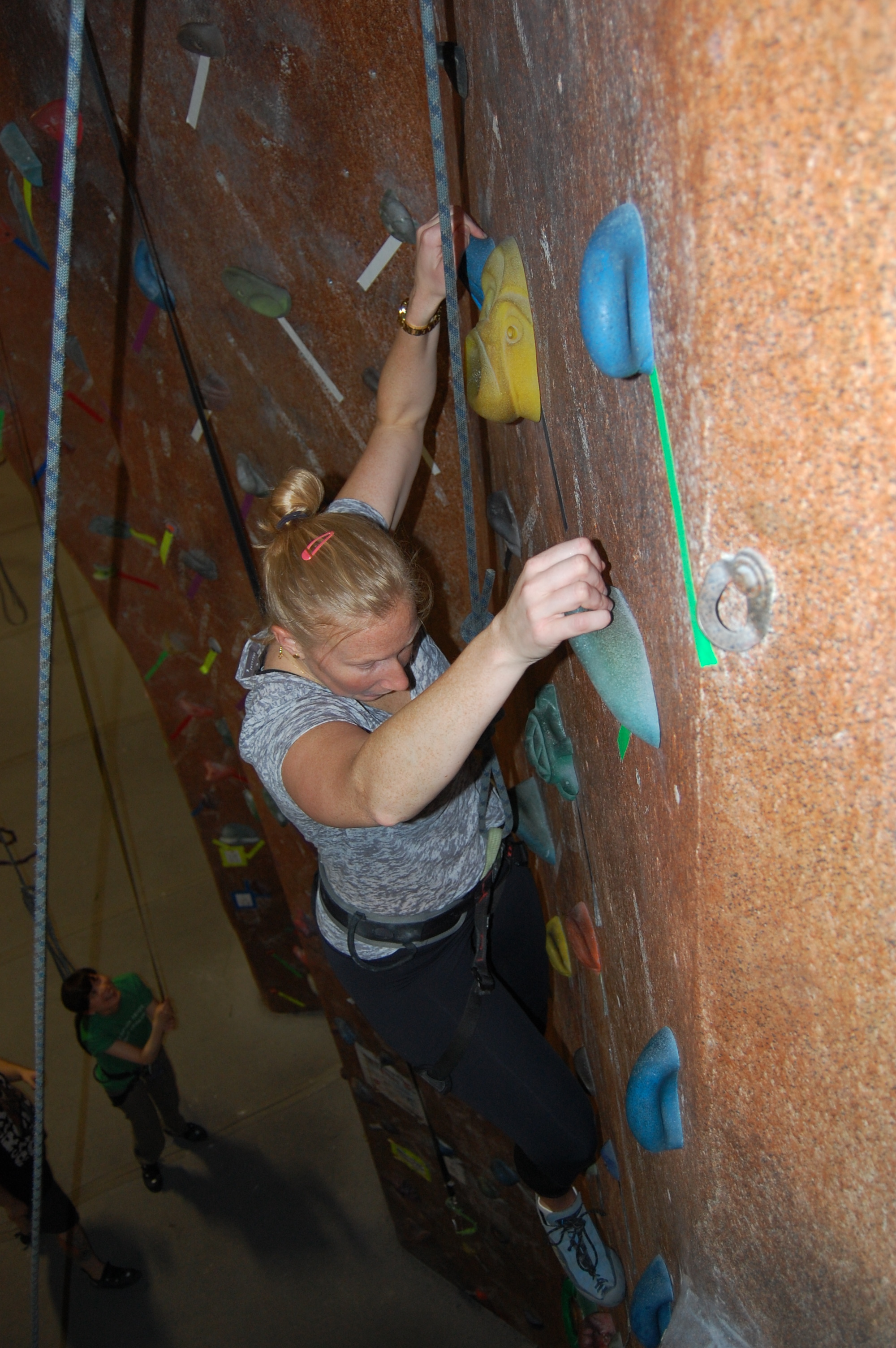
Half way up the wall

As I stepped up to the wall I told myself that I would just give it a chance, and that it didn’t really matter whether or not I was proficient at climbing vertical surfaces. To my great surprise I scampered up the wall at a pretty good pace.  One reason for that pace was that my hands were burning so much that I was not sure how much longer they would be able to cling to the wall. There were a few moments where I was unsure of where to place my feet, or when the next logical hand grip was just too far for me to reach, but I was climbing. I made it all the way up to the top of the wall, and looked down and was truly surprised and impressed with myself. After a few moments of hanging out at the top of the wall, savoring my success, Arianna lowered me back down to the ground and we switched positions so that she could climb. We kept climbing for more than an hour, and while I was not quite as quick or agile on any of my subsequent climbs, it didn’t dampen my glow of accomplishment from my first assent.

Surprisingly, it seems as if self-doubt is becoming a recurring theme of this blog; me resigning myself to the fact that I will be bad at something before I even try it. This is surprising because generally speaking, I don’t think I lack self-confidence (mind you, I don’t have a plethora of it either).  This is something I am going to work on moving forward. The fact that I put myself in new, and sometimes ridiculously foreign situations on a weekly basis is proof of how fearless I am. You never know what you will be good at — or what you will develop a passion for — until you try.

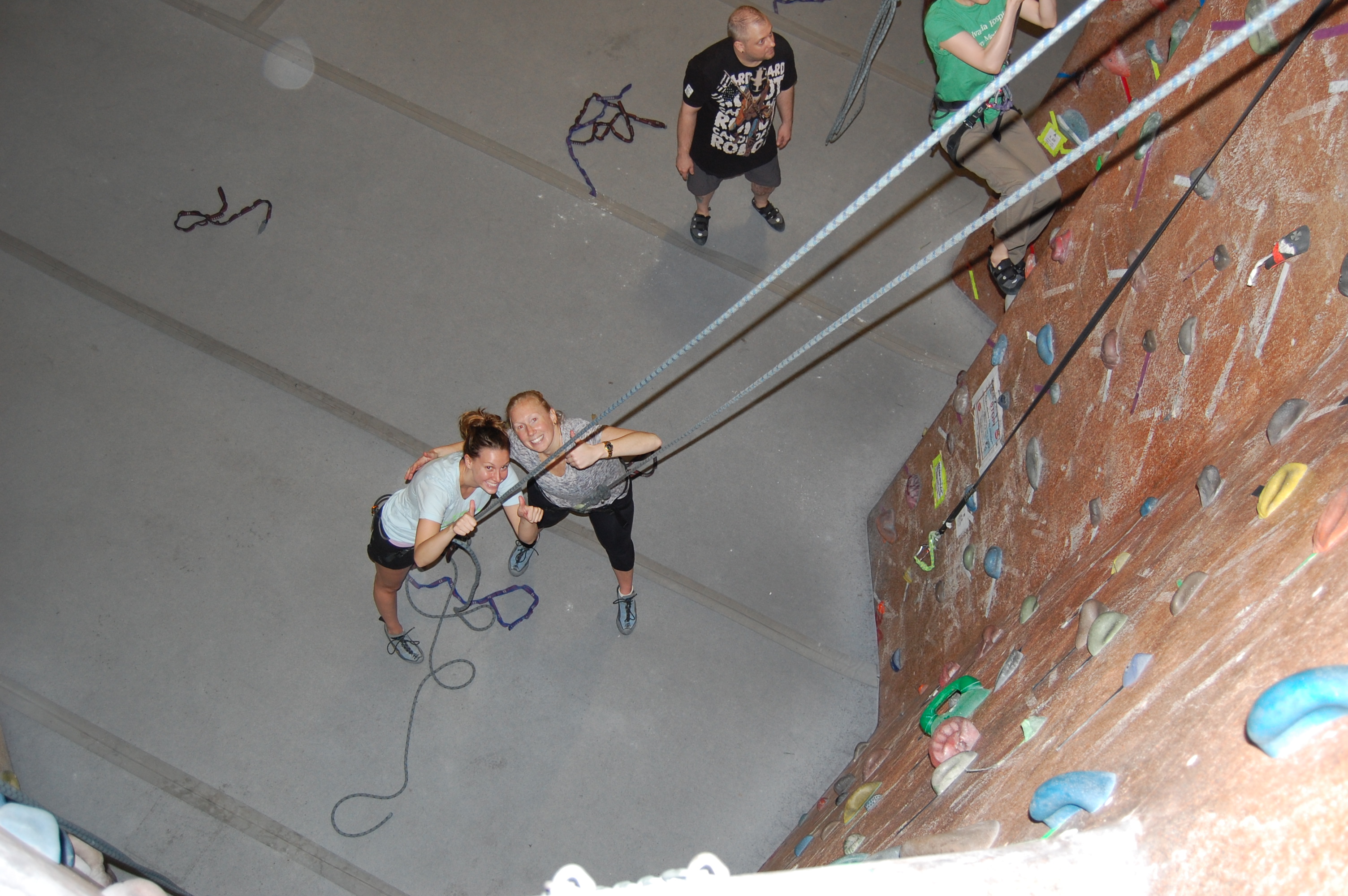
Two very happy climbers

Many thanks to Arianna Rubinstein along with Lindsay and all the folks at Rock Spot Climbing for their help. I was not compensated in any way for this post.

Clear Eyes, Full Hearts, Can’t Win

How do you feel about Eric Taylor?  If you immediately say you love him, you wish he was your coach, your dad or your brother, please skip to the next paragraph.  If you are scratching your head because you are not familiar with Coach Taylor, continue reading.  Eric Taylor is the fictional coach of the Dillon Panthers football team (later the East Dillon Lions), and the grounding force for not only his players, but for the entire amazing series “Friday Night Lights.”  I loved this show, and my anticipation of the upcoming movie can barely be contained.

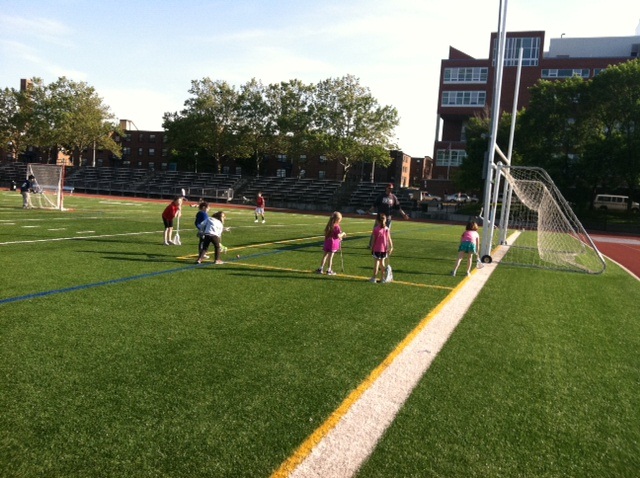
Eric Taylor makes me want to be a coach.  Football season is over, so I had to find an alternative, so I settled for lacrosse!  I played lacrosse for seven years (middle school, high school and one year of club lacrosse in college), and while I anticipated many things about the sport may have changed since the last time I picked up my stick –first a foremost being the stick itself – I was confident that I had something to offer lacrosse stars of the future.  And by future I mean 2023 specifically. That’s right, I volunteered to help a small cadre of dedicated individuals who coach lacrosse to 5-year-old girls in Charlestown. I was aptly wearing my Panthers T-shirt.

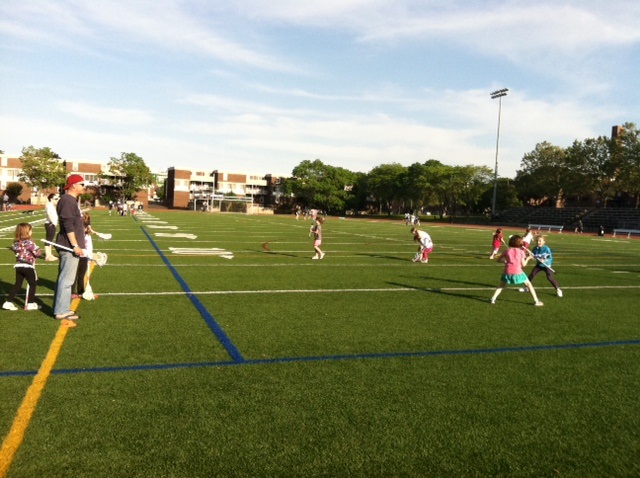
Four on four

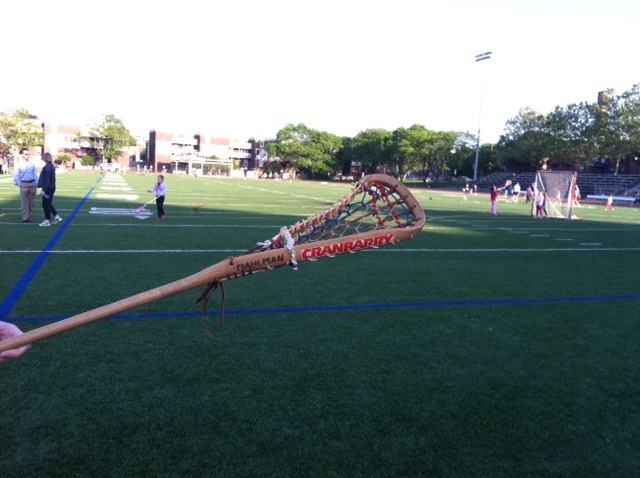
I was the new coach, so I understood that the girls may be a little wary of me at first, but it took me no time at all to realize that they were not looking at me with trepidation, they were looking at my stick.  Yes, the lacrosse stick I was using – and I have used since middle school — is not made of the light-weight, colorful plastic like the sticks all these little ones use. It is made of wood (see below). I had to explain to them that this was a “vintage” stick and everyone played with wooden sticks in the late 90’s.  “The late 90’s?” the girls cooed with wonder as if I was talking about the Depression or some other far-off time.

My “vintage” stick from the late 1990’s

We started stretching after the girls “took a lap,” the command a fellow coach told me to employ whenever I was not sure of what else to do, a brilliant suggestion. Counting out loud while stretching with all the girls after we ran took me back to my lacrosse days.  I was reminded how much I loved the sport and being a part of a team, not to mention how close I was with my teammates. I was instantly excited to be a part of that same experience in these little girls’ lives.

We tried some drills, which were a little on the sloppy side, but then again these girls were five, even Coach Taylor would cut them some slack. Then we planned to scrimmage, four on four.  I explained that one team would be offense and the other would be defense. With great theatric effect, complete with hand motions to motivate the girls, I told them that we would run down the field and the offense would try to score and the defensive team would try to intercept the ball. That’s when all their little faces went blank.  It took me a full minute to realize I was using words that these five-year-olds had not learned yet.  They had no idea what “intercept” meant.  When I said “stay on your man,” they were scratching their heads because they did not see any men, they were all little girls.

It was more difficult than I expected to explain to them how to do something without using my normal lexicon. After I went over my instructions again with a more elementary vocabulary, I brought them all in for a cheer, just like Coach Taylor would do.  I repeated his mantra “clear eyes, full hearts, can’t lose” to them slowly, but after a few minutes of misquoting and some pointing to each other’s eyes and noses, we settled on “go pink” instead. My players were all dressed in pink and they understood all those words. Coach Taylor would be proud of my improvisation.

They never really got the hang of scrimmaging and my pink team was over-powered by their opponents, a team that was not quite organized enough to come up with a name or cheer, but who had a height advantage. The phrases “get open,” and “pass down the field” were over their heads, so everything I was shouting from the sidelines was futile, and I got frustrated with my inability to speak their language.  Then I reminded myself that they were having fun — their squeals and smiles were proof of that — and when it comes down to it, that’s all that really matters.

When one little girl ran over to me and asked, in all seriousness, if we could play duck-duck goose next, a wide grin broke out over my face.  Coach Taylor would go ballistic if Landry asked to play another sport during practice, but these were not the Panthers, so I let her take a bathroom break instead of taking a lap.

Many thanks to the wonderful coaches in Charlestown for letting me help them, and especially to Laura Montgomery for her limitless support of this blog.

I Have a Secret

I will just come right out and say it: I took a pole dancing class. Yes that’s right, pole dancing.  No need to scroll down, you will find no pictures here!

Now that I have regained your attention…I went to this pole dancing…I mean “Pole Fitness” class and I thought I would feature it in this blog, but I got cold feet.  I was worried what people would think.  I didn’t have this feeling before I tended bar, or before I learned to arrange flowers.  I was worried I would look back at the post and be embarrassed, but I didn’t have this fear when I hung upside-down with my butt in the air struggling with a trapeze.  Why was this shiny pole any different?

Of course, it is obvious why it was different, but should that matter? As the wise Haitian philosopher Wyclef Jean so eloquently put it, “Just ‘cause she dance the go-go, don’t make her a ho, no.”

I was worried that people, that you who read this blog, would think badly of me for trying pole dancing. I now realize, that a) I shouldn’t care so much what people think of me (although I do want you all to be entertained and invested in my journey) and that b) I created this blog because I was exhausted by always doing the “right” thing, so why take a step back now? Heck, if I want to quit my job tomorrow and get a job at Centerfolds then gosh darn it, I should do that!

What I realized while at the class was that it takes a lot of work, and a lot of strength to pole dance.  These ladies can hold themselves in the air vertically, with the pole clenched between their thighs. They were not dressed like floosies, they were dress the same as me in tank tops and yoga pants, although their pants were a foot or so shorter than mine.

My instructor must have been an athlete at some point in her life, although when I asked her how she learned to dance she offered the suspicious answer of “I just picked it up.”  No matter, she was truly amazing and elegant and at the end of class showed us some tricks…not those kinds of tricks…get your mind out of the gutter!

I was not a good pole dancer; I don’t have the strength.  I landed on my knees with loud thuds and I had bruises for weeks.  When I was a child (and let’s be honest, I still hear it to this day) my mother would often console me by saying, “You can’t be good at everything, Emily,” and I take that to heart now.

I walk away from this experience with the resolution not to hold back on these pages, to trust myself enough to try anything, and trust you, my readers, not to judge.

I took my class at Pole Fitness Boston, and I highly recommend it if you are interested in giving it a try.  I was not compensated in any way for this post. 

Ready, Set…Let Go

To be honest, (and why lie in a self-indulgent blog read only by a gaggle fabulous friends) my decision to go to trapeze school was a little superficial.  I thought it would be dramatic, provide ridiculous pictures…but I admit it was a gimicie “adventure.”  I never for a second thought I might actually become a trapeze artist or any other type of circus performer no matter how quickly I took to trapeze.  I am not particularly afraid of heights, so I wouldn’t be overcoming a life-long fear.  I was actually more nervous about wearing yoga pants in public than flying through the air two stories above the ground.  But it surprisingly turned out to be a tremendous learning experience for me.

I won’t mince words: I am terrible at the trapeze.  Ter-ri-ble.  Probably the worst person to ever attempt this airborne apparatus.

I showed up for class at the Trapeze School New York in Reading, Massachusetts with two friends: one who was taking the class with me, another to document my attempt to fly through the air with the greatest of ease.  As it turns out nothing I did on the trapeze that day came easily.
Getting ready to fly
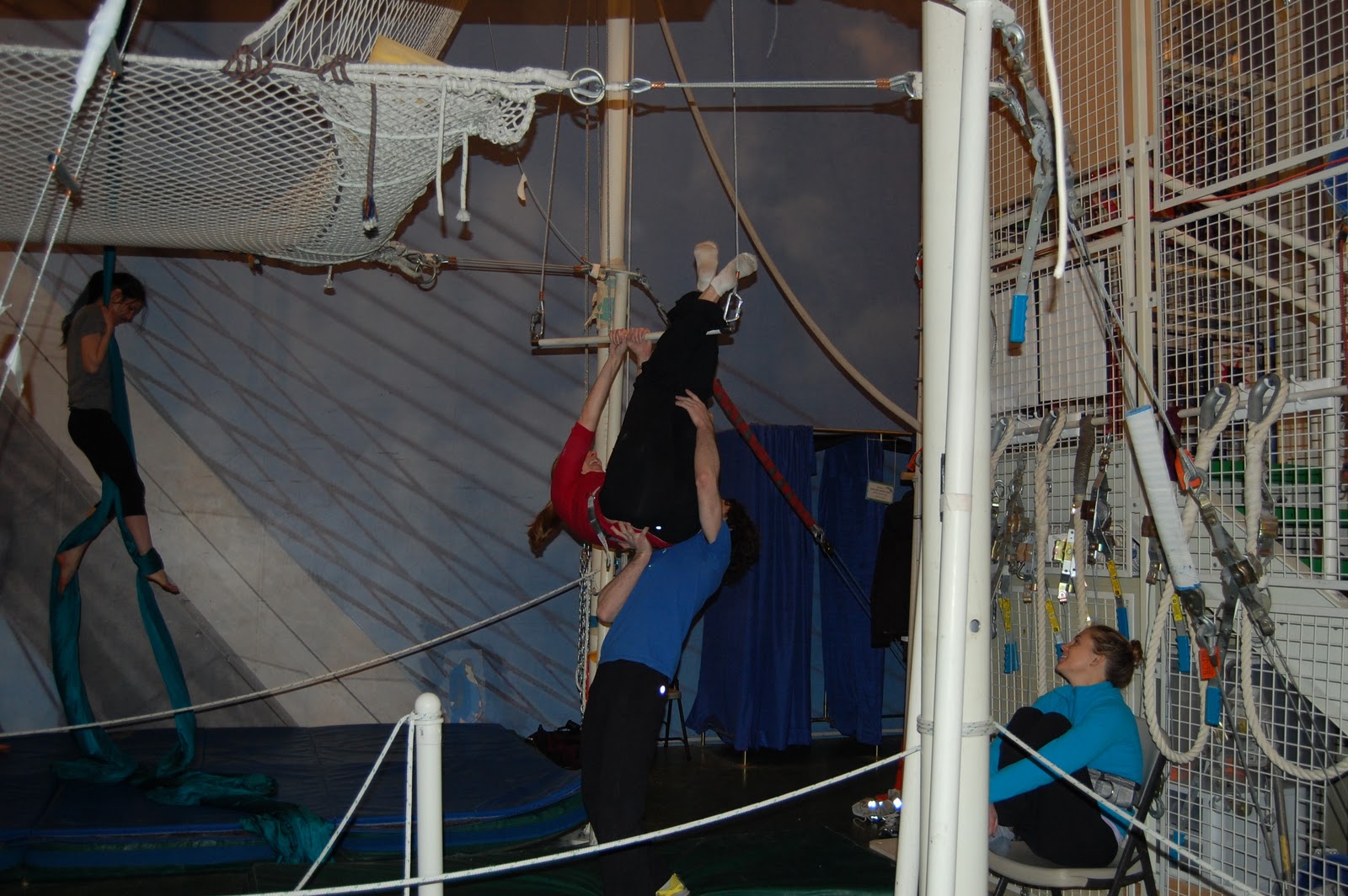
The instructors talked us through what we would be doing: swinging on the trapeze with our hands hip width apart, then at the precisely right point we would hook our legs around the bar then let go!  We would then swing upside-down with our arms extended, then grab the bar again, unhook our legs while continuing to swing.  Finally we would dismount by doing a back flip and land on the padded net below.  Easy, right?  Well, they said it would be, if we listened to them and did what they told us to do when they told us to do it.  I asked a barrage of questions about timing and the impact of one’s body weight and flexibility (or in my case the lack there of).  The instructors dutifully answered all my questions, but kept reminding me, “You just have to listen to us.”  When I responded that I was a good listener so that would not be a problem, one of the teachers was skeptical.  He had seen a lot of different personalities here, he explained to me, and I struck him as someone who thinks too much. Of course, he was totally right.  I always believe I can figure out a better way to do something, and I was doing that as I prepared to take on the trapeze.
One by one we climbed up two stories to a platform where we were hooked onto safety lines.  Very quickly (I assume so we did not chicken out) we were instructed to stand with our toes on the edge of the deck.  “Ready?”  I bent my legs.  “Hup?” I hopped off the platform and was flying through the air. I should have known that jumping off the platform wouldn’t be the hard part.
Attempting to “hook my legs”
I was moving too fast to focus on anything.  I know the instructor on the ground must have said, “Hook your legs,” but I didn’t hear a thing.  I did attempt to hoist my legs up over the bar, but I was told afterward that I did it before I was told to.  I could not get my legs up over the bar.  I swung back and forth trying in vain to lift them up. Nothing.  I dismounted — no back flip for me — by flopping to the mat.  I needed to stop thinking and just listen I was told.  I went back up to the top and tried swinging again. “The first swing is for fear, the second swing is for fun,” they said.  I was actually more terrified the second time.  I knew what to expect this time around.  My hands burned from hanging on to the bar for dear life and I had a funny feeling in my stomach…something between nervousness and nausea.
My private trapeze tutorial not going very well
Again I tried to lift my legs and hook them over the trapeze bar.  Again…nothing.  My hands burned so much I was worried I was going to lose my grip.  After this swing, my friend and I  (she had not yet hooked her leg either – thank goodness I was not the only one) were taken to a practice area on the ground with a bar that was about five feet above the ground.  It felt like trapeze Special Ed.  Here I got some one-on-one assistance, and even then I could not hook my legs.  My instructor said that maybe I should try a different technique to get my legs up and over the bar.  Instead of having my arms shoulder width apart on the bar and bringing my legs up, and between my torso and the bar, I would swing with my hands right next to each other on the bar, I would bring my legs around the bar (spread eagle) then hook them over the bar outside of my arms.  This, they called “hocks style.”  I was the only one using this technique and every time I swung, the instructor would yell “Hocks,” because I really needed even more attention drawn to the fact that I was the worst trapeze student ever.
Hocks Style
After a few swings attempting hock style I still had not been able to hook my legs.  My friend had gracefully mastered hooking her legs and I was the only member of the class (which included children) who had yet to do it.  I was extremely frustrated, but then I actually resigned myself to the fact that I would not be able to do it.  I am not particularly good at being bad at things, but I was impressed with my ability to rationalize the fact that if the flying trapeze was one of the things in my life that I am not good at, that was ok.  I started to think that maybe I would sit out the rest of the class and spare myself the embarrassment of squirming mid-air above spectators.  I figured that the lesson I would take away from this adventure would be that I am not going to excel at everything I attempt…and that is just fine.
I climbed up the stairs to the platform one last time, comfortable with the fact that I was not going to hook my legs.  As I approached the edge of the platform for what I thought would be my final swing, Jen one of the instructor said, “Just stop thinking.  Let go.  Listen to him (him being the instructor who was giving me commands during my swing from the ground).”  I repeated her manta to myself a few times before I jumped off the platform. “Just let go.  Just let go.”  This time as I flew through the air I could actually hear the instructions “hook your legs” and I did!  It was not easy, fast or graceful but somehow I managed to get my legs around the bar and hook them over.  I released my grip on the bar when told and flew upside down with my arms extended.  Then I heard “hands on,” which meant I should grab the bar once again, unhook my legs and prepare to dismount.  I grabbed the bar again, but when I tried to unhook my legs I realized that a corner of my yoga pants was wedged between my palm and the bar.  I started to wiggle my grip in an attempt to free my pants.  This seemed to go on for quite a while.  In reality I am hoping no one noticed, but judging from the applause coming from my classmates and two friends below everyone noticed.  When I finally got my feet back on solid ground I realized that my instructors were right: it didn’t take that much strength or flexibility to hook my legs.  What it took was for me to relax…let go…and listen to the experts.  I had to surrender in order to succeed.

I managed to hook my legs for a second time on my next swing.  The rest of the class was moving on to “catching” when another person on a second trapeze grabs them by their outstretched arms and their legs slide off the bar.  I was feeling pretty proud of myself, satisfied with the experience and comfortable with the skills I had acquired, so I skipped the catching part.  I thought I should end on a high note…and not press my luck.

Thanks go to Laura and Cori for coming with me.  Two familiar smiles in the face if total humiliation and unexpected success made all the difference.  I’d also like to thank all the instructors at Trapeze School New York for their help and their patience.  They believed in me when I did not believe in myself.  They also taught me a very valuable lesson, one that I will continue to work on: Relax…let go.  Its amazing what you can accomplish when you stop stressing.

Click here to see more pictures from my trapeze adventure.  While I took my class at Trapeze School New York, I was not compensated in any way for this post.